






































AI governance for banks in Switzerland and Germany: what FINMA and BaFin expect
FINMA and BaFin have not written a separate AI rulebook. Both supervisors apply the rules banks already follow, and they read AI into them.
That makes AI governance less exotic than vendors suggest. It also removes the excuse. A bank that runs model risk, outsourcing and ICT risk well already owns most of the controls. What it usually lacks is evidence: proof, per AI system, that the controls ran.
The rules that apply to AI in banks
| Source | Applies to | Binding? | What it asks for |
| FINMA Guidance 08/2024 | Swiss banks | Supervisory expectation | Clear accountability, robust and unbiased models, good data quality, explainable results, independent review |
| BaFin guidance on ICT risks and AI (Dec 2025) | German banks | No | AI handled as ICT risk under DORA |
| DORA, Regulation (EU) 2022/2554 | EU banks | Yes, since 17 Jan 2025 | ICT risk management, incident reporting, third-party oversight, resilience testing |
| ECB Guide to internal models (rev. Jul 2025) | Banks with internal models under ECB supervision | Supervisory expectation | Explainability and justified complexity for machine learning models |
| EU AI Act, Regulation (EU) 2024/1689 | Providers and deployers of AI in the EU | Yes | Extra duties for high-risk systems, including credit scoring of individuals |
| Digital Omnibus, Regulation (EU) 2026/1744 | Same | Yes | High-risk duties start 2 December 2027 instead of August 2026 |
Status as of October 2026. Dates change. Check this table before you plan against it.
What FINMA expects
FINMA Guidance 08/2024 reads like an audit checklist. We design from it as one.
A Swiss bank should expect its auditor to ask for three things. An inventory of the AI systems in use. A risk class for each one. The tests behind each class, and who signed them off.
The guidance asks for independent review. In practice, that means the people who build a model are not the people who approve it.
What BaFin expects
BaFin looks at AI through ICT risk. An AI system is an ICT asset, so it falls under the DORA duties a German bank already has.
That has a practical consequence. An AI vendor is an ICT third-party provider. Its contract and the bank’s exit plan fall under the same DORA rules as any other ICT supplier.
The EU AI Act and credit scoring
The AI Act classes the creditworthiness assessment of natural persons as high-risk, under Annex III point 5(b). Retail credit scoring is the case most banks meet first.
The same point excludes AI systems used to detect financial fraud. Fraud detection still appears on many lists of high-risk examples. Under Annex III, it does not belong there.
Swiss banks are not under the AI Act directly. A Swiss bank whose AI output is used in the EU can fall inside it.
Where banks fall short
In 2025 the ECB ran AI workshops with 13 supervised banks. It published the findings in November 2025:
- About half of the banks had a dedicated AI policy.
- None had automated validation tools for AI models.
- None had an explicit fallback for when an AI system fails.
- Accountability in the second line of defence was the main gap.
These banks are large and well staffed. We expect a mid-sized cantonal bank or a German Sparkasse to start further back.
Validation practice in banks grew up around credit scorecards. A language model that answers customer emails, or an agent that calls internal systems, does not fit that practice.
Governance belongs on the platform, not in a policy document
A policy document describes controls. An auditor asks for proof that they ran. That proof has to come from where the models run.
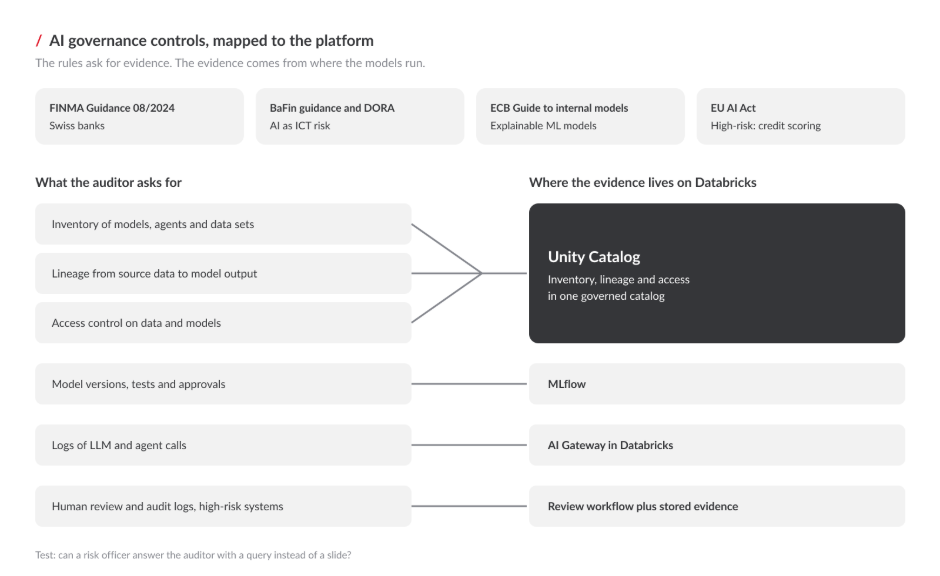
Figure 1. What supervisors ask for, and where the evidence lives on Databricks.
On Databricks, the controls map like this:
| Control | Where it runs |
| Inventory of models, agents and data sets | Unity Catalog |
| Lineage from source data to model output | Unity Catalog |
| Access control on data and models | Unity Catalog |
| Model versions, tests and approvals | MLflow |
| Logging of LLM and agent calls | AI Gateway in Databricks |
| Human review and audit logs for high-risk systems | Workflow plus stored evidence |
The test is simple. Can a risk officer answer the auditor’s question with a query instead of a slide?
Our banking experience
Our banking work is in Central and Eastern Europe, under EU rules: DORA, EBA guidelines and the AI Act.
One of our banking projects is a data platform migration for a major CEE bank. That bank agreed the solution with its national regulator before the work started. AI governance needs the same habit: evidence first, then the platform.
If you are setting up AI governance in a bank
Start with the inventory. You cannot classify, test or report on AI systems you have not listed.
Class each system under every regime that applies to you, at once. A credit model at a large German bank can answer to DORA, the ECB guide and the AI Act at the same time.
Put the evidence where the models run. A control without a log is an opinion.
Give the second line of defence its own access to that evidence. The ECB found this gap even at large supervised banks.
For more on our work with banks, visit our dedicated banking section.
